
-

Try advanced features for free
Get Smarter responses, upload files, create images, and more by logging in.
Log In Sign up & Earn $5

Is Deep Research AI Better Than Standard Chatbots?
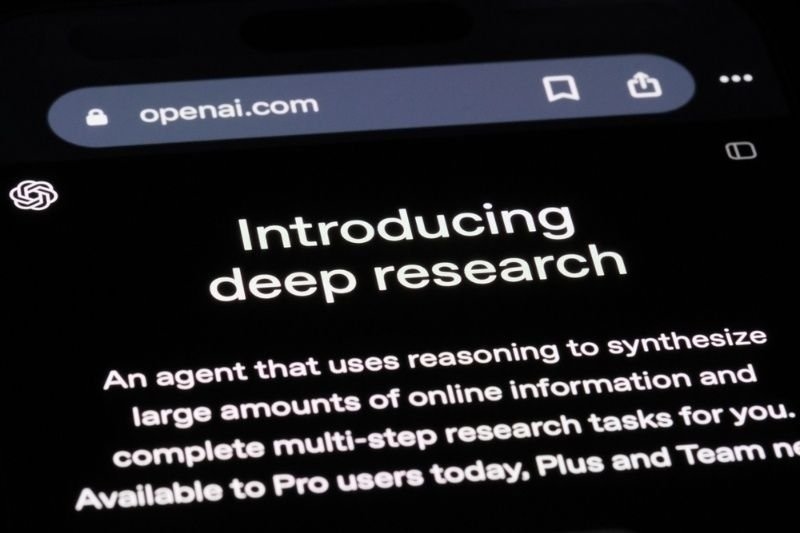
Deep Research AI is transforming the way we search, analyze, and use information. Standard chatbots can answer questions in seconds, but they often rely on existing training data and may not be able to complete complex research projects. The world of organizations now generates more data than ever before-it is estimated to reach 181 zettabytes globally by 2025-and thus the need for AI solutions beyond simple chatbots is evident for conducting thorough, fact-based research.
This is the reason why Deep Research AI is special. Unlike quick-response chatbots, it can investigate various resources, assess and analyze data, identify patterns, and deliver in-depth results. Businesses, researchers, and professionals all use data to inform their decisions, and knowing how deep research works is crucial. In this article, we are going to outline what Deep Research AI is, what differentiates it from a standard chatbot, and why its importance is now undeniable.
What is Deep Research AI?

Deep Research AI consists of sophisticated AI that performs demanding research tasks rather than simple conversation.
While the standard AI chatbot generates the answer as you ask a question, Deep Research AI can:
- Search for information from a variety of sources
- Detect and evaluate conflicting sources
- Identify patterns and tendencies
- Summarize the findings
- Produce conclusions based on evidence
The sole aim is to provide understanding and context, rather than just the answer.
How is Deep Research AI Different From Standard Chatbots?
The obvious answer to this question is "the depth of research."
While standard chatbots can provide rapid answers, Deep Research AI aims to explore, analyze, and draw conclusions before presenting the final answer.
Normal Chatbots
These are the types of AI mainly used for:
- Customer Service
- Simple queries
- Drafting copy
- Daily chores
- Simple problems
- Focus on speed and user experience.
Deep Research AI
Deep Research AI is suited for:
- Searching multiple resources
- Validating facts
- Interpreting data
- Extensive research
- Strategic business development
The focus here is more on accuracy and detail, not speed.
How Does Deep Research Work?
There is a procedure behind the detailed answer provided by a deep research AI, which can also help to understand how it functions.
Step 1: Retrieval of information
The AI obtains a lot more useful and trustworthy information than a typical chatbot.
Step 2: Contextualization
It examines relationships between the resources as well as inconsistencies or contradictions. It processes the information retrieved.
Step 3: Comparison of data
It verifies the collected data against additional information and provides supporting or conflicting evidence.
Step 4: Deduction of insights
Using analysis across multiple resources, it arrives at a definitive answer supported by a complex analysis. This is similar to how humans conduct research for important projects.
Why are Standard Chatbots Often Not Sufficient?
Standard chatbots, although an amazing invention, are limited to some extent:
Limited analysis of resources
They may not actively compare different data sources to ascertain the accuracy of the information presented.
Limited context understanding
Complex and niche subjects may require a higher level of comprehension than simple question-and-answer systems are built to handle.
Shallow analysis
For crucial research in business, academia, and markets, you need in-depth information, which a chatbot can rarely produce.
These are only some reasons why Deep Research AI systems are becoming widely accepted and integrated in organizations.
What are the Benefits of Deep Research AI?
Deep Research AI can be a valuable tool across many fields, such as:
Decision-making
Once you have a large amount of factual research, you can make a decision more readily at the right time and have full confidence that it is the correct one.
Time-consuming research
This process typically takes a few days/weeks when undertaken by a human, but with Deep Research AI, it takes only a matter of minutes and is applicable to many fields.
Accurate data
When facts are taken from multiple sources, the risk of being misinformed is much smaller.
Increased productivity
Researchers can spend more time acting on the information they obtain rather than physically gathering it.
Where is Deep Research AI being Used?
Adoption of Deep Research AI is rapid and is already present in:
Business Intelligence
Companies use this tool to scan markets and assess trends, competitors, and customers.
Academic Research-Many researchers are using AI for the examination of complex studies and published articles.
Health Care
This tool can be used to examine clinical data and test new treatments and practices.
Financial Services
Investment firms use AI to conduct extensive market and industry analyses to understand industry developments and trends.
This is why the demand for research-focused AI is growing.
Can Deep Research AI Replace Human Researchers?
No, not completely.
While it dramatically boosts the speed and capacity of human researchers, human intelligence is irreplaceable. The researchers possess:
- Critical thinking skills
- Ethics and morals
A deep level of expertise and knowledge of the topic or area.
The ability to come up with new solutions to complex problems.
When combined, the capabilities of both human and AI result in the highest efficiency and quality of output.
What are the Challenges of Deep Research AI?
Every technology has its drawbacks.
Information Quality
The AI can only rely on the quality of information it has access to.
Bias Risks
If the available data is biased or incomplete, the analysis may be equally biased or inaccurate.
Verification needs
Some decision-making will have to be approved by a human.
Data privacy issues
Organizations must ensure they comply with the privacy and security laws in place.
When selecting an efficient Deep Research AI platform, certain features should be considered: the AI must make its data source available to its users. It should be a deep analysis and not a summary.
There should be some controls to verify the accuracy of information. The system should be user-friendly.
Conclusion
The future of AI is about more than simply having a conversation. Deep Research AI represents the progression of artificial intelligence in delivering relevant data analysis. While everyday chatbots address our routine questions, research-driven AI looks deeper, examining the myriad of available information to ensure the knowledge it provides is accurate and matches what is being sought. We've broken down Deep Research AI and how it works and is different from everyday chatbots, what it can deliver, how enhanced AI analysis is beneficial, and how it is being utilized in industry today.
As data continues to grow, so will the need for AI to translate vast amounts of data into actionable, informed results. With the use of deep research AI platforms like Perplex.com, users are no longer limited to basic AI communication but can conduct in-depth research and gain deeper insights.
FAQ
Is Deep Research AI Useful for Small Businesses?
Yes. Small companies can use these systems to analyze market trends and the business climate, identify opportunities, and support the growth and development of their business. By reducing the time they would have previously spent on this time-consuming task, they can obtain vital information that was previously accessible only to larger corporations and research divisions.
How Long Does Deep Research AI Typically Take?
The time Deep Research AI takes varies depending on the complexity of the request and the amount of data used. For simpler research, this process can take only a few minutes; for more complex research, it may take longer.
Can Deep Research AI Assist With Identifying Trending Data?
Yes, because they are capable of searching through such large quantities of online documents, including reports, studies, research papers, analyses, and other online data sources, Deep Research AI can easily analyze patterns within such large, complex sets of data and identify future trends and market developments.
Recommended Articles

Conversational AI Trends and I...
Just a few years back, talking to most AI felt like chatting with a robot...
Read More
How to Improve AI Search Accur...
AI search accuracy is about how effectively a system is able to ...
Read More

What can I help you with?
Unlock more with PerplexPlus
PerplexPlus gives you higher limits, smarter models, and more.