
-

Try advanced features for free
Get Smarter responses, upload files, create images, and more by logging in.
Log In Sign up & Earn $5

AI Privacy Overview: Risks, Concerns, and Data Protection
Key Takeaways
- Whether an AI is privacy-preserving or not depends on the type of data that you provide and how an AI service gathers, stores, and processes the data.
- Privacy risks of AI can take the form of storing and retaining data, accessing it without permission, profiling, and breaches of privacy where private information is disclosed.
- AI Data Privacy includes prompts, uploaded files, account info, and any other personal information.
- AI protection begins by not exposing a lot of personal or sensitive data.
- Knowing this about how AI handles personal data allows you to make more informed choices.
- Remove additional data exposure with privacy controls and technology.
AI drives your writing, research, planning, and daily life-but AI can also involve data and personal info. Wondering why AI privacy is important? Not only could your prompts or uploaded files have financial, health, or work-related data, but they could also have sensitive personal details that you may not want to disclose.
What is AI Privacy?
The term "AI privacy" refers to your private data when you use artificial intelligence. While an AI conversation might have as much data as an average online search, typical AI interaction is more information-rich because users give more context, documents, images, and follow-up questions.
This can lead to numerous AI privacy concerns. The data collection process may be unclear to the user, including the type of data collected, the retention period, the potential usage for the AI model, and whether a different provider would process their data. Different AI services have varying privacy policies.
Privacy worries also apply to the information a system infers. There are many innocuous pieces of information that, when aggregated, could paint a larger picture of a person's interests, situations, or actions.
How AI Uses Personal Data?
Here's how AI uses personal data. The topic of what's done with the prompt is only part of the story. For example, some personal data include a conversation, an upload of a file or photo, account details, device information, and activity.
For instance, some services allow data to be used to train their models, whereas others give you the option to restrict certain uses. Business-specific services may offer differentiated contractual protections. It's always a good idea to check the privacy policy of a particular provider.
Another way in which AI handles lots of information is that it can spot patterns. This raises issues for AI privacy because some information becomes more valuable when combined with other data.
What are the Main AI Privacy Risks?
One of the biggest AI privacy risks is inadvertently giving out sensitive data without knowing what it will do with it. Conversations with AI can seem personal, so it's tempting to tell the AI more than we should. Some risks include:
- Inappropriate sharing of information: Customer records, health, legal, workplace, and relationship information can be a source of AI privacy concerns.
- Saving information: Your provider may save your chats or other information for a period of time.
- Train the model: Your conversations can be used to improve AI systems, subject to the service and settings.
- Profiling: Some information can be combined to create new information.
- Third-party processing: The third-party vendor offers the service on its resources or systems.
- Security events: Data could potentially be accessed during a data breach.
The more you regularly open up to AI over time, the greater your privacy risks. Multiple interactions can give away more than just one.
Protecting Data From AI: Practical Ways
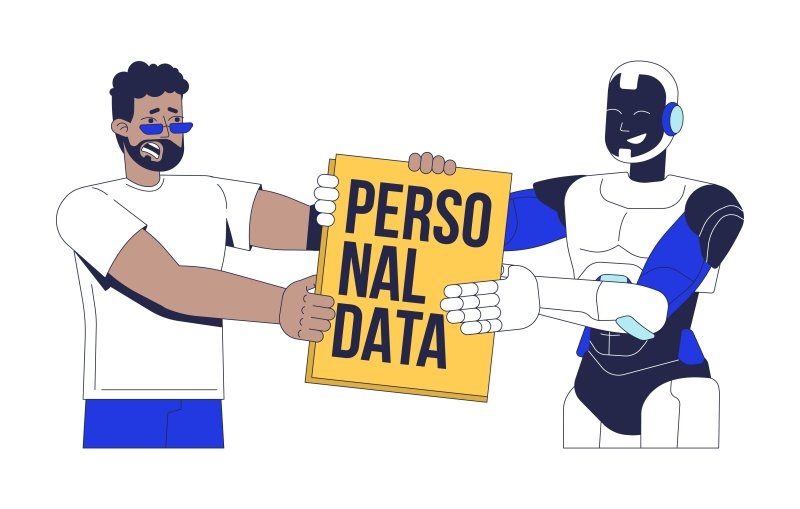
Here are some practical ways of protecting data from AI: The first step to protecting your data from AI is to give it only the data it requires for a particular task. When asking AI to summarize a file, you may not need to name addresses, phone numbers, account numbers, or other personal identification.
Make all sensitive data anonymous by replacing it with 'customer,' 'staff member,' or something similar. Or, submit only those extracts of the document required for the reviewer to see rather than the whole document. Seek details on conversation history, retention, model training, deletion, third-party sharing, and temporary conversations.
Simple Ways to Protect Your Information
Having good AI data privacy habits can simply become an element of your technology-dependent life. There is no need to cut out AI; you simply need to be mindful of what you are sharing. Useful habits include:
- Delete all non-essential names, addresses, phone numbers, and account information.
- Never share passwords, security PINs, or other login codes.
- Don't upload full confidential documents if you only need a portion.
- Determine if conversations may be utilized for AI model training.
- Be sure to review retention and deletion policies before sharing sensitive material.
- Think about local AI tools if you want to hold information on your machine.
These measures also make it easier to control sensitive data coming into an AI system.
AI Data Privacy is Not Just About a Setting
Providers may also adopt policies that limit access to the data before it's used to train algorithms. Certain (but not all) of the platforms and tools associated with the use of AI also have technical controls that limit access to data in use.
The AI program can be set up on a machine locally, so prompts and files remain within that device. Cloud services are accessed from a distance but could have higher privacy and data security measures.
Knowing this difference is helpful when comparing tools. A privacy policy states how a provider claims information will be stored, while technical safeguards restrict access to that information.
What You Should Avoid Sharing With AI?
A straightforward way to address AI privacy issues is to not provide anything to an AI system that it doesn't need. Be deliberate about sharing passwords, authentication codes, full financial records, proprietary business information, private legal files, or extremely sensitive information about yourself.
Consider the information of other people. Also, do not type other people's private information, such as family, friends, customers, and coworkers. Never type it if it does not seem to be worth it.
Keep in mind that not all services treat personal data in the same way. The privacy option that we have in one of our products may not be in the services that you use, so make sure to check before giving your data.
Converting AI Privacy Into An Everyday Practice
Solid AI privacy practices shouldn't hinder AI productivity. Prior to submission, consider if a prompt or message needs to be submitted, whether the information can be stripped of identifying details, and whether you understand what the service does with what you submit.
Revisit privacy preferences-because AI providers may update their features, policies, and data practices. Being in the know allows you to weigh the impact of a feature's new design on the amount of needless data you contribute while still being able to enjoy the power of AI.
Conclusion
AI privacy is an aspect of data protection. AI allows us to do things faster and more conveniently, yet users need to be aware of what they reveal to AI and how that data can be used. Prioritizing privacy and limiting AI access to sensitive data can protect against privacy issues.
Frequently Asked Questions
Is it possible for AI to recognize an individual from an anonymous prompt?
It may be possible at times if several pieces of information are put together. Details about a person's employer, hometown, home location, significant other, social life, or something unusual may provide enough details to single out a person or at least narrow the field.
Can I undo someone's reply?
Not always. Deleting a conversation from your account doesn't always mean that all of its backups, logs, or records have been wiped. It's the company's policy and procedures around deleting information.
Can AI remember personal information between conversations?
Certain AI services may have memory or personalization features that allow them to remember some details through different conversations. This will vary between individual products, so look into the memory and privacy options for that service.
Are local AI tools more private?
Local AI can minimize some privacy risks since prompts and files may stay on your computer instead of sending information to a cloud provider. Security also depends on your computer, software, model, and configuration.
Should businesses have separate AI privacy rules?
Yes. Businesses are able to consume customer data, personnel information, financial data, and protected IP. Clear instructions can also lay down which AI tools are allowed, what data can be accessed, access controls and retention, and how employees can utilize the systems.
Recommended Articles

Which are the Best AI Email Wr...
Key TakeawaysThe best AI email writing tools take the sting out...
Read More
Why AI Answer Engines are the ...
AI answer engines are a search system that gives you clear and d...
Read More

What can I help you with?
Unlock more with PerplexPlus
PerplexPlus gives you higher limits, smarter models, and more.